



“We Don’t Know Where to Hide”: The Daily Struggle of Civilians in Idlib
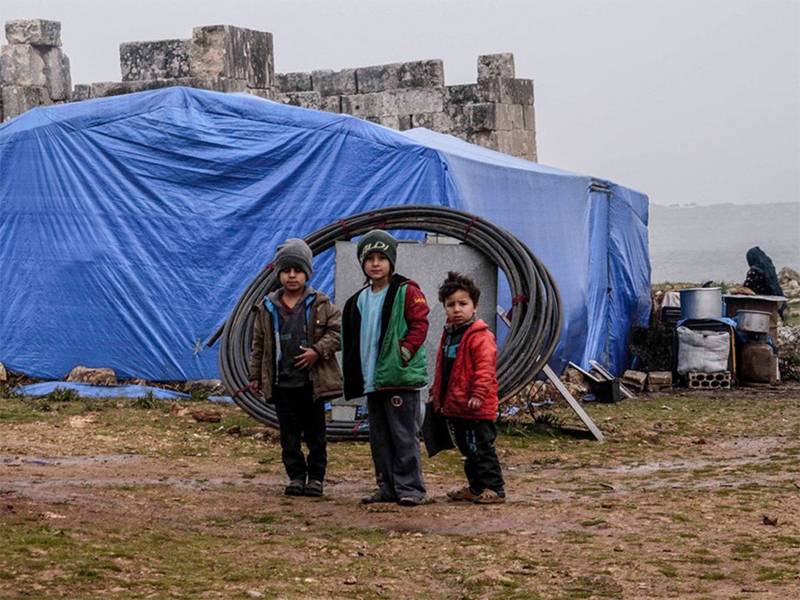
Hadeeth returns home from work, climbing the stairs in a dark corridor to her apartment on the fifth floor in the city of Idlib, northwest Syria. She points to the doors of neighbors who have been displaced from other parts of the country.
“These are from Deir Ezzor, those from Aleppo, and those from Damascus,” she says, catching her breath.
These geographic names reflect the path of a war that entered its tenth year on Sunday. The conflict has displaced 6 million Syrians internally, while a roughly equal number have fled abroad. Many internally displaced persons (IDPs) have arrived in this city, still the last urban stronghold of opposition forces resisting President Bashar al-Assad’s regime. During the war, the population of Idlib governorate has doubled, reaching approximately 3 million.
Even in Hadeeth’s neighborhood, considered middle-class, electricity is available for only two hours per day, and the building’s elevator is out of service. Yet in a conflict that has claimed over 100,000 civilian lives due to Syrian and Russian attacks, these problems rank low on her list of worries.
Hadeeth, a 41-year-old divorced mother of two and a native of Idlib, says: “We all suffer from water and electricity shortages, and from a life full of dangers.”
Intense Syrian and Russian airstrikes and ground clashes forced nearly a million civilians toward the Turkish border earlier this year, prompting Turkey to strike Syrian forces. A ceasefire agreement between Turkey and Russia remains in place this month, but few displaced Syrians trust it enough to return home—even if their houses are still standing.
The Syrian economy has collapsed due to war and sanctions. Even those with stable jobs find it impossible to pay for electricity from generators. In her small living room, a red-and-brown couch occupies half the space along a peeling wall. Mold grows on the ceiling. She has tried to make the room cozy, hanging a painting of a natural landscape on the wall and placing a guitar without strings in the corner as decoration.
Outside the small balcony, a large crater lies in the adjacent building’s grounds. It has been there since the building was leveled by a bombing two years ago, which killed 35 people. A year ago, another attack killed a 14-year-old girl, her body falling in front of Hadeeth’s building entrance. That night, while fleeing in the dark from the rockets, Hadeeth and others accidentally stepped on the girl’s body. The memory still haunts her. She and her children live in constant fear of being the next victims.
Leave a Reply
Your email address will not be published. Required fields are marked *
Search
Category